

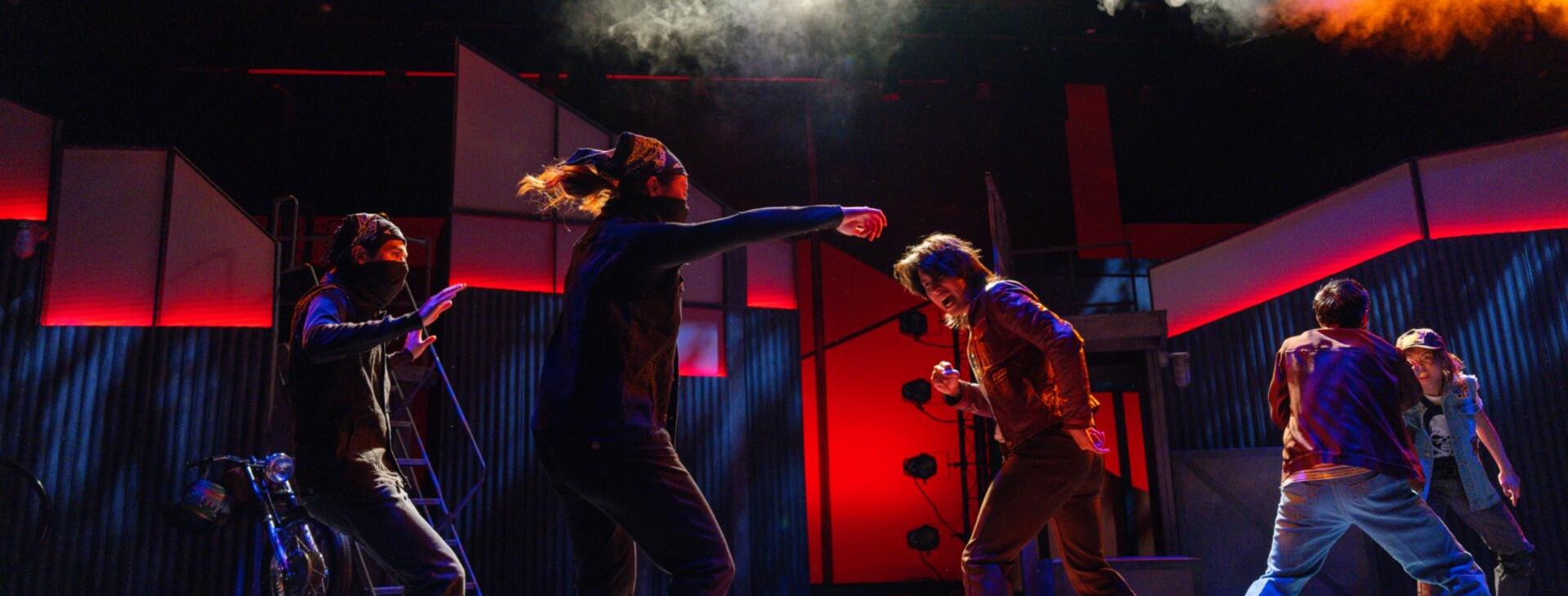
Welcome to the Department of Theatre, Film, and Digital Production!
A Welcome Note and Mission Statement from the Department Chair
To those just getting to know us, greetings! I hope the following answers many of the questions you may have about the Department of Theatre, Film, and Digital Production (TFDP).
TFDP is best described as both an academic and a practice-based program. We offer a holistic, liberal arts education, taught by nationally and internationally acclaimed professional practitioner-scholars. Our faculty have written and directed award-winning, canonical, independent, and experimental films and documentaries (Real Women Have Curves, When I Sing, This Dissonance), have taken original plays–along with UCR staff, student and/or alumni cast and crew–to international venues around the world, including winning top honors at the Edinburgh Fringe Festival (Dreamscape, Tilly No-Body). They have designed, produced, and acted for theatre, film, and television (August: Osage County, Reservation Dogs, NCIS), edited Emmy-nominated and winning films and TV series (Cheer, RAFA, Monsters), are leaders and board members of professional organizations in their fields (American Theatre and Drama Society, University Film and Video Association), and have written acclaimed and groundbreaking articles and books (Feeling Yellow: Asian Americans and Yellowface in Twenty-First-Century Musical Theatre, Naked Playwriting, Well Crafted, Well Said: Public Speaking from Draft to Delivery, The Multilingual Art of Commedia dell’Arte, Acting: The Basics, and The Routledge Companion to Latine and Caribbean Musical Theatre).
Furthermore, most of our faculty are multi-hyphenates, who write both academic publications as well as write, perform, design, dramaturg and/or direct productions, in what we define as practice-based research. Many of these activities are public-facing by nature, and often involve community outreach and engagement. The department is focused on storytelling in all areas of dramatic production, theory, and history, as fundamental to the ongoing expression of the human experience.
Our Mission Statement:
TFDP’s mission is to teach and train filmmakers, theatre professionals, and storytellers who can bring previously untold and under-represented stories into the light; in distinction with more Hollywood-industry-related schools like USC or UCLA (though we attend to “Hollywood'' as well), our program is devoted to the creative projects, scholastic advancements, and professional opportunities that speak to the backgrounds and concerns of our diverse student body.
As we foreground collaboration, multifaceted creative processes, and expansion of the traditional “canon,” we:
● Engage in storytelling through different media - theatre, film, and digital production - to help our students understand the mechanics and the range of narrative drama and related media.
● Empower storytellers to develop their unique voices as reflective of their social, cultural, and historical backgrounds and present experiences.
● Emphasize the analytical and practical skills our students will need to pursue their chosen career paths as actors, directors, writers, designers, performance scholars, dramaturges, and filmmakers–as well as those pursuing other career choices.
● Educate researcher-practitioners who can think critically about their community, society, and world, and respond with insight and creativity to their place within it.
Also, while most other schools separate theatre, film, and television, our exceptional program attends to all these genres in addition to new media and critical studies. Our philosophy is that the separation of these arts is artificial, unrealistic, and unrepresentative of the professional world. Writers, actors, directors and designers move back and forth between theatre, film, TV, commercials, online applications, and writing books and articles, each discipline informs the others.
Our students gain tools across all genres, tools that help them to find meaningful, productive careers and enact social change. They land jobs from being set crew members and producers to actors and directors in the industry, and they gain admission to prominent graduate schools including USC and UCLA. Furthermore, the skills they acquire in TFDP transfer to other fields such as education and communication, as employers increasingly value arts and humanities degrees.
Our program is designed, therefore, to educate the holistic student artist by exposing them to a wide breadth of media and professional artists, emphasizing the practical application of skills in story-making to empower them to use and build their unique voices in the fields and communities both within and beyond our classrooms.
As far as outcomes: It bears emphasizing that the skills students acquire in our program are applicable in a wide range of fields beyond the dramatic arts: gaining clear and effective presentation skills, the ability to communicate well with others and collaborate, to show up on time (!) and use their imaginations to solve problems and think outside the box (or set). The demonstrated strengths of a background in film and theatre studies are often unrecognized but are real, attractive, and meaningful in the workplace.
It is our department’s fundamental philosophy that storytelling is how we experience and construct the patterns and meanings of our lives. Our students, whose life experiences are culturally wide-ranging and experientially rich, have valuable, original, and as-yet unheard stories to tell the world. We are here to help them tell those stories.
– Robin U. Russin, Professor and Chair, TFDP
Upcoming Events
Latest News
Black Lives Matter
The department of Theatre, Film & Digital Production at the University of California, Riverside joins the chorus of voices calling for justice for the numerous Black lives taken at the hands of law enforcement as represented by the recent killing of George Floyd, Breonna Taylor, and Ahmaud Arbery.
When those sworn to “Protect and Serve” us kill Black people, the echoes of protests from around the world resonate in a special way in Riverside. UCR sits but a few miles away from the corner of Central and Brockton avenues where 19-year-old Tyisha Miller was killed by Riverside police officers in 1998, an event that generated demonstrations, calls for change, a trial, and the usual acquittal of the officers who put 12 bullets into her unconscious body. It also led to the play Dreamscape, written by Rickerby Hinds which explored the antagonistic relationship between the police and the Black community, as well as its film adaptation My Name Is Myeisha; The Riverside Coalition for Police Accountability was also established. But the work continues.
Our campus is the most diverse of the 10 University of California sister campuses and has the greatest number of Black students. Unfortunately, in spite of this reality, or perhaps because of it, our Black students find themselves dealing with issues from racial profiling by our own officers to sidelining Black voices in our syllabi, and so much more. From campus police to the classroom, from the street to stage and screen, we can do better. We will do better. But the struggle continues.
We say unequivocally: Black Students Matter. Black Stories Matter. Black Lives Matter.
“Until justice rolls down like waters…” - Dr. Martin Luther King Jr.
Recognition of Native Lands
We acknowledge that the land on which we gather is the original and traditional territory of Tongva people [Tongva and Cahuilla people] and within Tongva, Cahuilla, Luiseño, and Serrano original lands and contemporary territories.
In the spirit of Rupert and Jeanette Costo’s founding relationship to our campus, we would like to respectfully acknowledge and recognize our responsibility to the original and current caretakers of this land, water, and air: the Cahuilla, Tongva, Luiseño, and Serrano peoples and all of their ancestors and descendants, past, present, and future. Today this meeting place is home to many Indigenous peoples from all over the world, including UCR faculty, students, and staff, and we are grateful to have the opportunity to live and work on these homelands.